 Add to Chrome
 Add to Firefox
 Add to Edge
Region Seeding via Pre-Activation Regularization: A Geometric View from Piecewise Affine Nerual Networks
May 07, 2026
Deep networks with continuous piecewise affine activations induce polyhedral partitions of the input space, making the number of realized affine regions a natural measure of expressive capacity and a key determinant of how well the model can approximate nonlinear target functions. In practice, standard training realizes far fewer region refinements in data-visited neighborhoods than the architecture could in principle support, while existing region-count theory is primarily architectural and offers little guidance on how optimization shapes the realized partition near the data. Our theory provides a sufficient condition under which bringing neuron switching surfaces sufficiently close to data points ensures their intersection with local neighborhoods, which in turn implies a strict increase in the local affine-region count, yielding a principled training-time handle for seeding data-relevant partitions early in optimization. Guided by these results, we propose a plug-and-play region-seeding regularizer that encourages early partitioning while allowing task-driven refinement to dominate later in training. Experiments show that the regularizer increases the number of realized affine regions via exact enumeration and improves overall performance on toy datasets, while also improving early-stage accuracy and achieving comparable (or slightly improved) final accuracy on ImageNet-1k for classical models.

AffineLens: Capturing the Continuous Piecewise Affine Functions of Neural Networks
May 07, 2026Piecewise affine neural networks (PANNs) provide a principled geometric perspective on neural network expressivity by characterizing the input--output map as a continuous piecewise affine (CPA) function whose complexity is governed by the number, arrangement, and shapes of its affine regions. However, existing interpretability and expressivity analyses often rely on indirect proxies (e.g., activation statistics or theoretical upper bounds) and rarely offer practical, accurate tools for enumerating and visualizing the induced region partition under realistic architectures and bounded input domains. In this work, we present AffineLens, a unified framework for computing the hyperplane arrangements and polyhedral structures underlying PANNs. Given a calibrated (bounded) input polytope, AffineLens identifies the subset of neuron-induced hyperplanes that intersect the domain, enumerates the resulting affine sub-regions in a layer-wise manner, and returns provably non-empty maximal CPA regions together with interior representatives. The framework further provides visualizations of region partitioning and decision boundaries, enabling qualitative inspection alongside quantitative region counts. By exploiting the affine restriction property of CPA networks under fixed activation patterns, AffineLens supports a broad class of modern components, including batch normalization, pooling, residual connections, multilayer perceptrons, and convolutional layers. Finally, we use AffineLens to perform a systematic empirical study of architectural expressivity, comparing networks through region complexity metrics and revealing how design choices influence the geometry of learned functions.
Training-Time Batch Normalization Reshapes Local Partition Geometry in Piecewise-Affine Networks
May 06, 2026Batch normalization (BN) is central to modern deep networks, but its effect on the realized function during training remains less understood than its optimization benefits. We study training-time BN in continuous piecewise-affine (CPA) networks through the geometry of switching hyperplanes and the induced affine-region partition. Conditioned on a mini-batch, we show that BN defines for each neuron a reference hyperplane through the batch centroid, and that breakpoint-switching hyperplanes are parallel translates whose offsets are expressed in batch-standardized coordinates and are independent of the raw bias. This yields an exact criterion for when a switching hyperplane intersects a local $\ell_\infty$ window and motivates a local region-density functional based on exact affine-region counts. Under explicit sufficient conditions, we show that BN increases expected local partition refinement in ReLU and more general piecewise-affine networks, and that this mechanism transfers locally through depth inside parent affine regions where the upstream representation map is an affine embedding. These results provide a function-level geometric account of training-time BN as a batch-conditional recentering mechanism near the data.
Adaptive Delayed-Update Cyclic Algorithm for Variational Inequalities
Mar 31, 2026Cyclic block coordinate methods are a fundamental class of first-order algorithms, widely used in practice for their simplicity and strong empirical performance. Yet, their theoretical behavior remains challenging to explain, and setting their step sizes -- beyond classical coordinate descent for minimization -- typically requires careful tuning or line-search machinery. In this work, we develop $\texttt{ADUCA}$ (Adaptive Delayed-Update Cyclic Algorithm), a cyclic algorithm addressing a broad class of Minty variational inequalities with monotone Lipschitz operators. $\texttt{ADUCA}$ is parameter-free: it requires no global or block-wise Lipschitz constants and uses no per-epoch line search, except at initialization. A key feature of the algorithm is using operator information delayed by a full cycle, which makes the algorithm compatible with parallel and distributed implementations, and attractive due to weakened synchronization requirements across blocks. We prove that $\texttt{ADUCA}$ attains (near) optimal global oracle complexity as a function of target error $ε>0,$ scaling with $1/ε$ for monotone operators, or with $\log^2(1/ε)$ for operators that are strongly monotone.
KARMA: Knowledge-Action Regularized Multimodal Alignment for Personalized Search at Taobao
Mar 24, 2026Large Language Models (LLMs) are equipped with profound semantic knowledge, making them a natural choice for injecting semantic generalization into personalized search systems. However, in practice we find that directly fine-tuning LLMs on industrial personalized tasks (e.g. next item prediction) often yields suboptimal results. We attribute this bottleneck to a critical Knowledge--Action Gap: the inherent conflict between preserving pre-trained semantic knowledge and aligning with specific personalized actions by discriminative objectives. Empirically, action-only training objectives induce Semantic Collapse, such as attention ``sinks''. This degradation severely cripples the LLM's generalization, failing to bring improvements to personalized search systems. We propose KARMA (Knowledge--Action Regularized Multimodal Alignment), a unified framework that treats semantic reconstruction as a train-only regularizer. KARMA optimizes a next-interest embedding for retrieval (Action) while enforcing semantic decodability (Knowledge) through two complementary objectives: (i) history-conditioned semantic generation, which anchors optimization to the LLM's native next-token distribution, and (ii) embedding-conditioned semantic reconstruction, which constrains the interest embedding to remain semantically recoverable. On Taobao search system, KARMA mitigates semantic collapse (attention-sink analysis) and improves both action metrics and semantic fidelity. In ablations, semantic decodability yields up to +22.5 HR@200. With KARMA, we achieve +0.25 CTR AUC in ranking, +1.86 HR in pre-ranking and +2.51 HR in recalling. Deployed online with low inference overhead at ranking stage, KARMA drives +0.5% increase in Item Click.
Image Aesthetic Reasoning via HCM-GRPO: Empowering Compact Model for Superior Performance
Nov 13, 2025The performance of image generation has been significantly improved in recent years. However, the study of image screening is rare and its performance with Multimodal Large Language Models (MLLMs) is unsatisfactory due to the lack of data and the weak image aesthetic reasoning ability in MLLMs. In this work, we propose a complete solution to address these problems in terms of data and methodology. For data, we collect a comprehensive image screening dataset with over 128k samples, about 640k images. Each sample consists of an original image, four generated images. The dataset evaluates the image aesthetic reasoning ability under four aspects: appearance deformation, physical shadow, placement layout, and extension rationality. Regarding data annotation, we investigate multiple approaches, including purely manual, fully automated, and answer-driven annotations, to acquire high-quality chains of thought (CoT) data in the most cost-effective manner. Methodologically, we introduce a Hard Cases Mining (HCM) strategy with a Dynamic Proportional Accuracy (DPA) reward into the Group Relative Policy Optimization (GRPO) framework, called HCM-GRPO. This enhanced method demonstrates superior image aesthetic reasoning capabilities compared to the original GRPO. Our experimental results reveal that even state-of-the-art closed-source MLLMs, such as GPT4o and Qwen-VL-Max, exhibit performance akin to random guessing in image aesthetic reasoning. In contrast, by leveraging the HCM-GRPO, we are able to surpass the scores of both large-scale open-source and leading closed-source models with a much smaller model.
ADIEE: Automatic Dataset Creation and Scorer for Instruction-Guided Image Editing Evaluation
Jul 09, 2025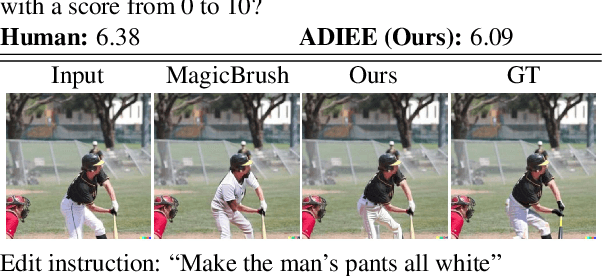

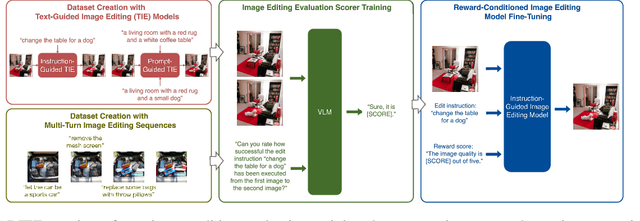
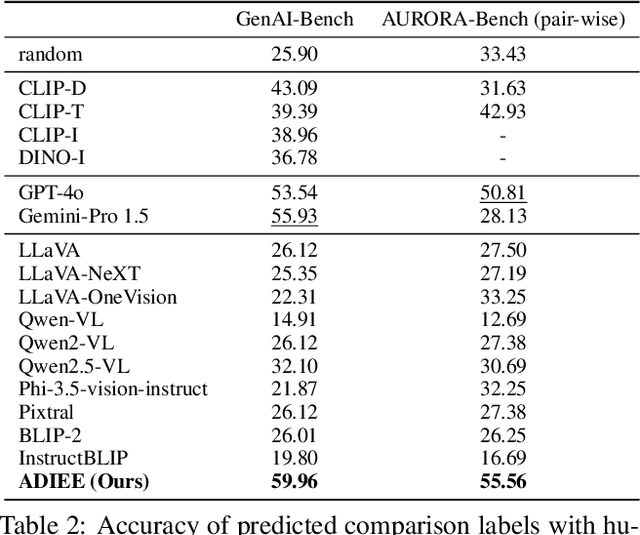
Recent advances in instruction-guided image editing underscore the need for effective automated evaluation. While Vision-Language Models (VLMs) have been explored as judges, open-source models struggle with alignment, and proprietary models lack transparency and cost efficiency. Additionally, no public training datasets exist to fine-tune open-source VLMs, only small benchmarks with diverse evaluation schemes. To address this, we introduce ADIEE, an automated dataset creation approach which is then used to train a scoring model for instruction-guided image editing evaluation. We generate a large-scale dataset with over 100K samples and use it to fine-tune a LLaVA-NeXT-8B model modified to decode a numeric score from a custom token. The resulting scorer outperforms all open-source VLMs and Gemini-Pro 1.5 across all benchmarks, achieving a 0.0696 (+17.24%) gain in score correlation with human ratings on AURORA-Bench, and improving pair-wise comparison accuracy by 4.03% (+7.21%) on GenAI-Bench and 4.75% (+9.35%) on AURORA-Bench, respectively, compared to the state-of-the-art. The scorer can act as a reward model, enabling automated best edit selection and model fine-tuning. Notably, the proposed scorer can boost MagicBrush model's average evaluation score on ImagenHub from 5.90 to 6.43 (+8.98%).
Vision Generalist Model: A Survey
Jun 11, 2025Recently, we have witnessed the great success of the generalist model in natural language processing. The generalist model is a general framework trained with massive data and is able to process various downstream tasks simultaneously. Encouraged by their impressive performance, an increasing number of researchers are venturing into the realm of applying these models to computer vision tasks. However, the inputs and outputs of vision tasks are more diverse, and it is difficult to summarize them as a unified representation. In this paper, we provide a comprehensive overview of the vision generalist models, delving into their characteristics and capabilities within the field. First, we review the background, including the datasets, tasks, and benchmarks. Then, we dig into the design of frameworks that have been proposed in existing research, while also introducing the techniques employed to enhance their performance. To better help the researchers comprehend the area, we take a brief excursion into related domains, shedding light on their interconnections and potential synergies. To conclude, we provide some real-world application scenarios, undertake a thorough examination of the persistent challenges, and offer insights into possible directions for future research endeavors.
LinGuinE: Longitudinal Guidance Estimation for Volumetric Lung Tumour Segmentation
Jun 06, 2025Segmentation of lung gross tumour volumes is an important first step in radiotherapy and surgical intervention, and is starting to play a role in assessing chemotherapy response. Response to a drug is measured by tracking the tumour volumes over a series of CT scans over a time period i.e. a longitudinal study. However, there currently exist few solutions for automated or semi-automated longitudinal tumour segmentation. This paper introduces LinGuinE, an automated method to segment a longitudinal series of lung tumours. A radiologist must provide an initial input, indicating the location of the tumour in a CT scan at an arbitrary time point. LinGuinE samples points inside this tumour and propagates them to another time point using rigid registration. A click validity classifier selects points which still fall within the tumour; these are used to automatically create a segmentation in the new time point. We test LinGuinE on a dataset acquired from a phase 3 clinical trial for lung tumours and the publicly available 4-D lung CBCT dataset. We find that LinGuinE improves the Dice on both test sets by over 20% (p< 0.05) across 63 longitudinal studies. We show that any time point can be used as a starting point, conduct ablation experiments, and find that our LinGuinE setup yields the best results on both test datasets.
Image Aesthetic Reasoning: A New Benchmark for Medical Image Screening with MLLMs
May 29, 2025Multimodal Large Language Models (MLLMs) are of great application across many domains, such as multimodal understanding and generation. With the development of diffusion models (DM) and unified MLLMs, the performance of image generation has been significantly improved, however, the study of image screening is rare and its performance with MLLMs is unsatisfactory due to the lack of data and the week image aesthetic reasoning ability in MLLMs. In this work, we propose a complete solution to address these problems in terms of data and methodology. For data, we collect a comprehensive medical image screening dataset with 1500+ samples, each sample consists of a medical image, four generated images, and a multiple-choice answer. The dataset evaluates the aesthetic reasoning ability under four aspects: \textit{(1) Appearance Deformation, (2) Principles of Physical Lighting and Shadow, (3) Placement Layout, (4) Extension Rationality}. For methodology, we utilize long chains of thought (CoT) and Group Relative Policy Optimization with Dynamic Proportional Accuracy reward, called DPA-GRPO, to enhance the image aesthetic reasoning ability of MLLMs. Our experimental results reveal that even state-of-the-art closed-source MLLMs, such as GPT-4o and Qwen-VL-Max, exhibit performance akin to random guessing in image aesthetic reasoning. In contrast, by leveraging the reinforcement learning approach, we are able to surpass the score of both large-scale models and leading closed-source models using a much smaller model. We hope our attempt on medical image screening will serve as a regular configuration in image aesthetic reasoning in the future.